
What Are Spherical Roller Bearings?
A rolling-element bearing with spherical rollers that functions on the idea of rolling contact without sliding or fretting is referred to as a “spherical roller bearing”. Depending on whether there are one or two rows of balls between the inner and outer rings, it can be categorized as either a single row or a double row.
In spherical roller bearings, two rows of barrel-shaped, friction-reducing rollers are sandwiched between an inner ring with two inclined raceways and an outer ring with a spherical racetrack. These bearings are employed in numerous heavy-duty industrial applications because of their raceway geometry, which is appreciated for their capacity to correct misalignment and shock loads.
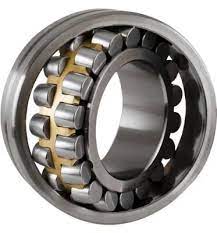
Spherical Roller Bearings Design
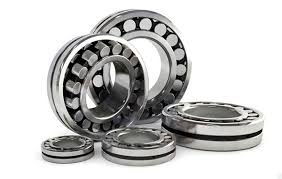
When the load you need to handlesurpasses the load rating of other types of bearings, such as standard ball bearings, you can utilize spherical roller bearings. Two rows of rolling elements in the outer ring are spaced apart by a radial gap. Both ends of these rolling components make contact with the inner racing surface.
The rolling elements can move freely within the radial gap because there isn’t a separate cage or retainer. They will always be aligned on their axis of rotation when the spherical roller rotates, therefore no further alignment technique is needed. Spherical roller bearings come in many different materials, so it’s important to choose the correct type for your application.
Spherical Roller Bearings are rolling element bearings that helps rotation with low friction and it also allows angular misalignment too. The misalignment is permitted due to the spherical internal shape of the outer ring and spherical rollers. Spherical roller bearings support rotating shaft into the bore of an inner ring that could be misaligned as compared to the outer ring.
As their name represents, they are NOT truly spherical in shape, the rolling elements in roller bearings are more cylindrical in shape, slightly over-inflated. Spherical roller bearings are used in varieties of industrial applications that have heavy loads and moderate speeds. Most common applications are wind turbines, gearboxes, pumps, mechanical fans, construction equipment, marine propulsions, off-roading vehicles, etc.
Factors for Determining the Effectiveness of Spherical Roller Bearings
Operating Temperature
The range of outside temperatures known as the operating temperature is where a bearing performs most consistently. Because lubricant viscosity rises in low-temperature conditions, a larger minimum load is needed.
Rotational Speed
The rotational speed known as the reference speed is the point at which the heat produced by rotation is equal to the heat released by the lubricant and the geometry of the bearings.
Maximum RPM
The maximum RPM at which the bearing is intended to function is known as the limiting speed. The strength of the bearing cage, the accuracy with which the bearing was produced, and the properties of the lubricant all play a role in this.
Minimal Load
A minimum axial load must be provided to the rollers of the bearing in order for it to operate at high speeds with stable acceleration and deceleration. This protects the cage against slipping or excessive friction as well as inertial forces.
Types of Spherical Roller Bearings
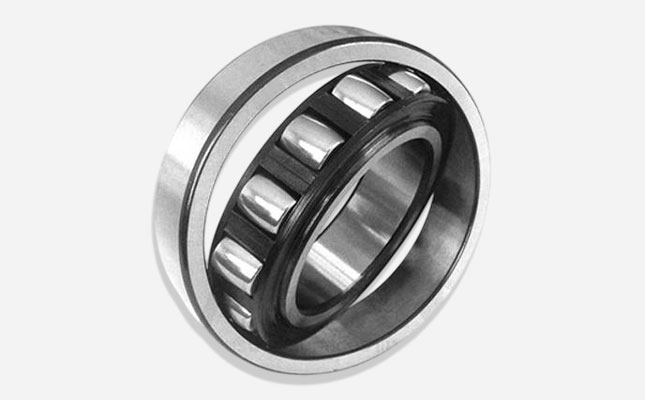
Single row Spherical Roller bearing
Single row Spherical Roller bearing
Single Row Spherical Roller Bearings that are suitable to reduce friction of a rotating surface.
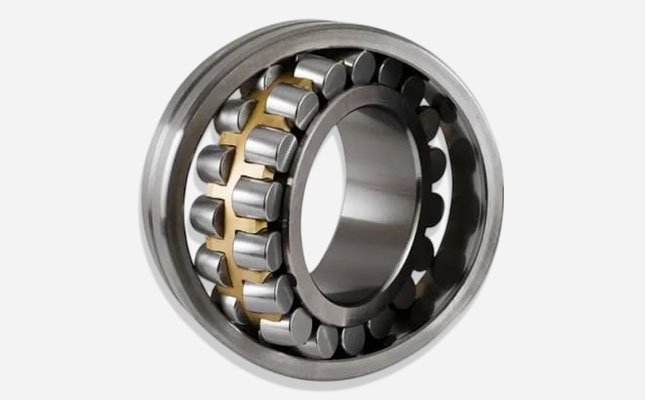
Double row Spherical Roller bearing
Double row Spherical Roller bearing
Double-row spherical roller bearings are suitable for large radial loads. They can also take some axial loads in either direction.
Applications Of Spherical Roller Bearings
Benefits Of Spherical Roller Bearings
- Due to the abundance of spherical rollers, these bearings offer an exceptional load-carrying capacity for radial, thrust, and combined loads in one direction.
- Because they are self-aligning, spherical roller thrust bearings can accommodate misalignment.
- These bearings may operate at speeds between moderate and high.
- Since spherical roller thrust bearings have a low coefficient of friction and thus, they require less maintenance.
- The spherical roller bearing can function pretty well when the ball bearings could not function due to its distinct design and efficiency.