
Adarsh Angular Contact Ball Bearings
Inner and outer ring raceways of angular contact ball bearings are separated from one another in the bearing axis direction. This indicates that these bearings are made to support mixed loads, such as concurrently acting axial and radial loads.
As the contact angle rises, angular contact ball bearings’ ability to support axial loads increases. The line connecting the ball’s points of contact with the raceways in the radial plane, along which the cumulative load is transferred from one raceway to the next, and a line perpendicular to the bearing axis is known as the contact angle.
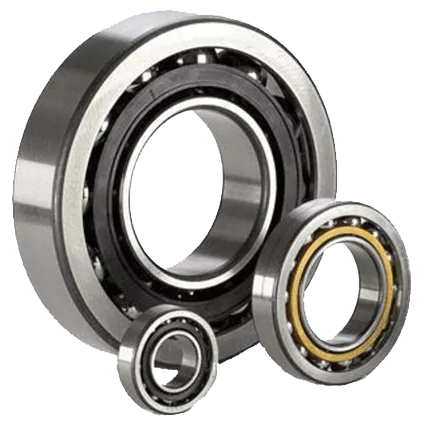
Angular Contact Ball Bearings Design
These Bearings are expertly crafted to exacting specifications to accommodate a variety of high-load applications. It is made up of cage, ring, and ball materials in terms of design. They can accommodate tilting movements since they have a contact angle between 15 and 25 degrees, whereas radial bearings only have a contact angle of 8 degrees.
Another factor is that angular contact ball bearings are made with one elevated shoulder on the outer ring, which makes them suitable for heavier loads and faster speeds.
Angular contact ball bearings have inner and outer ring raceways that are displaced relative to each other in the direction of the bearing axis.
This means that these bearings are designed to accommodate combined loads, i.e. simultaneously acting radial and axial loads.

Types of Angular Contact Ball Bearings
Angular Contact Ball Bearing Specifications
Withstand Axial And Radial Loads
With typical contact angles of 30° or 40°, these bearings are capable of supporting both radial and axial loads in one direction.
Maintain Axial Loads
Axial (thrust) loads can be applied in both directions to double-row angular Ball Bearings.
Different Contact Angles
Smaller contact angles are preferable for high-speed rotation, while larger contact angles provide a higher capacity for axial stresses.
Compact Style
A single inner ring and outer ring make up double-row angular contact ball bearings, which allow an integrated back-to-back mounting of two single-row.
Internal Clearance
The internal clearance of the two opposing bearings is changed. Although polyamide resin cages are mainly utilized for high-precision bearings with contact angles, pressed steel cages are still often used.
Applications Of Angular Contact Ball Bearings
Benefits Of Angular Contact Ball Bearings
- These bearings are more resilient and is able to support heavier loads for longer.
- Because these bearings have less friction than conventional varieties, they are more effective. Because of this, they use less energy to function, which can result in energy and operating cost savings.
- It can fit in nicely without utilizing numerous bearings in such situations where there is limited axial space.
- In usage circumstances where high rigidity and precision are of the utmost importance
- Compared to other bearing types, these bearings have a lower coefficient of friction.
